5 Tips for Improving Your Rock Climbing Skills
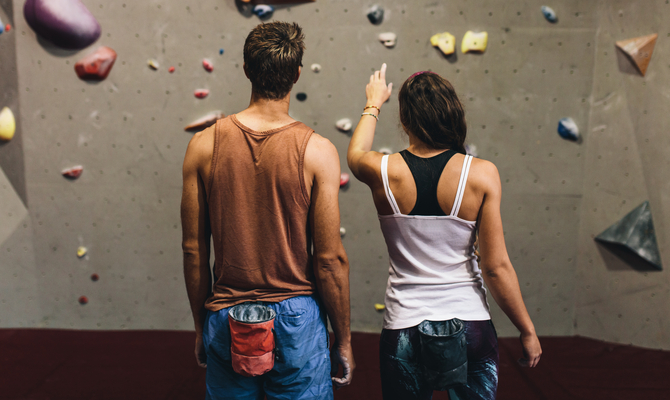
Indoor rock climbing is more popular than ever, with many people taking up the unique sport by joining climbing gyms. If you’re new to the sport of indoor climbing and want to improve your ability to climb, you’ve come to the right place. Below, we offer helpful tips for improving your rock climbing skills, from strength training to technique study.
Tip #1: Study Grip and Crimping Technique
One of the first steps to becoming a proficient climber is mastering various grip techniques. Knowing how to hold different types of holds can greatly improve your climbing. You must familiarize yourself with the many different crimp grips to crimp like a pro climber.
Other essential grips include the open-hand grip and the pinch grip. The open-hand grip is less taxing on your fingers and works well for larger holds, while the pinch grip is crucial for outward-extending holds. Practicing these grips through bouldering can significantly boost your hand strength and control.
Tip #2: Train Your Fingers and Grip
Finger strength is crucial for rock climbing and often determines your ability to tackle advanced routes. Adding finger and grip exercises to your training can yield impressive results. Tools like fingerboards, grip trainers, and hand grippers are excellent for building strength.
Start with simple exercises such as hanging from a fingerboard with an open-hand grip. Gradually move to more challenging routines like one-armed hangs or adding extra weight. Consistency is key, so include these exercises in your workouts several times a week.
Tip #3: Practice Your Footwork
While upper body strength gets the spotlight, effective climbing relies on precise footwork. Your feet are your foundation and positioning them correctly makes climbing much easier.
Practice edging, using the inside or outside edges of your shoes to stand on small holds. Smearing involves pressing the sole of your shoe against the rock when there are no defined holds. Focus on your foot placements and transfer your weight efficiently to conserve energy and climb more effectively.
Tip #4: Challenge Yourself Constantly
Stagnation hinders progress, especially in rock climbing. Continuously challenging yourself is crucial for skill development and growth. Push beyond your comfort zone in both training and climbing routes.
Once you’ve mastered a route, seek new challenges. Try different difficulty levels or explore new climbing gyms with varied terrains. Participating in competitions or group climbs can also offer fresh perspectives and motivation.
Tip #5: Practice, Practice, Practice
Perhaps the most important tip for improving your rock climbing skills we can offer is to practice as much as you can. Regular climbing sessions are key for building muscle memory, improving technique, and boosting confidence. Aim to climb several times a week, mixing in both bouldering and top-rope climbing.
Set goals for each session, such as mastering a new grip, improving footwork, or completing a tough route. Track your progress and celebrate your achievements, no matter how small. The more time you spend on the wall, the more you can fine-tune your skills and build your repertoire as a climber.
Conclusion
Rock climbing is a dynamic sport that requires continuous learning and adaptation. We hope our guide helps you enhance your climbing skills and love for the sport. If you dedicate your time to practicing, training, and challenging yourself enough, you’ll see your climbing skills flourish in no time.