Tools That Help Apply Drywall to Tall Walls and Ceilings
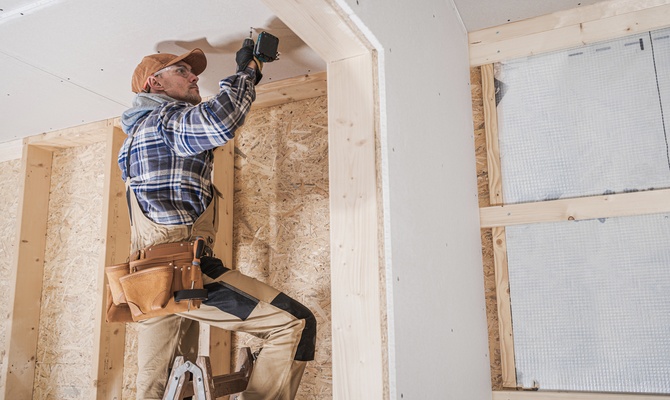
Applying drywall to average-height walls is easy enough. But what do you do if you have vaulted walls, or even ceilings to cover with drywall? For this, you’ll need tools to help elevate yourself, or your materials, to where they need to be. Here are five tools that help apply drywall to tall walls and ceilings worth having in your toolkit.
Scaffolding
A scaffolding system gives you a stable, elevated platform to work from. Unlike a single ladder, scaffolding spans a wider area, so you’re not constantly repositioning just to reach the next section of wall. Most residential scaffold setups are modular, meaning you stack and extend them to whatever height the job calls for. If you’re drywalling a two-story entryway or a cathedral ceiling, this is probably your most practical option for sustained work at elevation.
Drywall Lifts
Ceiling work is where most solo drywall jobs hit a wall, so to speak. Holding a heavy sheet overhead while trying to fasten it is a two-person job by default. A drywall lift solves that problem. You load the panel onto the lift’s cradle at floor level, crank it up to the ceiling, and lock it in place. From there, you can secure the sheet without a second set of hands. Lifts are widely available at tool rental shops, so you don’t have to buy one outright.
Drywall Stilts
Drywall stilts are another option that can help you install drywall at height. Stilts feature an adjustable footplate on an elevated pole system where you place your foot, and a knee brace to further stabilize the leg. If you’re a first-time user, it can take a while to adjust the stilts so they fit just right. But once secured, you can walk around in the stilts and cover ground much faster than repositioning a ladder every few feet. They work especially well for walls, where you need to move laterally across long runs.
Extension Handles
Extension handles attach to your drywall tools, including screw guns and rasp blades, so you can reach higher without constantly moving a ladder. They’re particularly useful for finishing work like sanding and screw driving along upper walls. They’re not a replacement for a lift or scaffolding when you’re actually hanging heavy sheets, but great for detail work once the drywall is up.
T-Braces (Deadmen)
A T-brace, sometimes called a deadman, is a simple but useful piece of equipment. It’s essentially a T-shaped prop, usually cut from lumber, sized to wedge between the floor and ceiling. Once in place, it holds a drywall panel tight against the ceiling framing while you fasten it. It’s not a replacement for a lift on big jobs, but for shorter ceiling runs or when you’re working with a helper, a deadman brace is a low-cost way to get the panel where it needs to be and keep it there.
The Right Tools Change Everything
Not every job calls for all five of these tools designed for applying drywall to tall walls and ceilings, but knowing what’s available means you’re never stuck trying to hold a 70-pound sheet over your head with one hand again.